

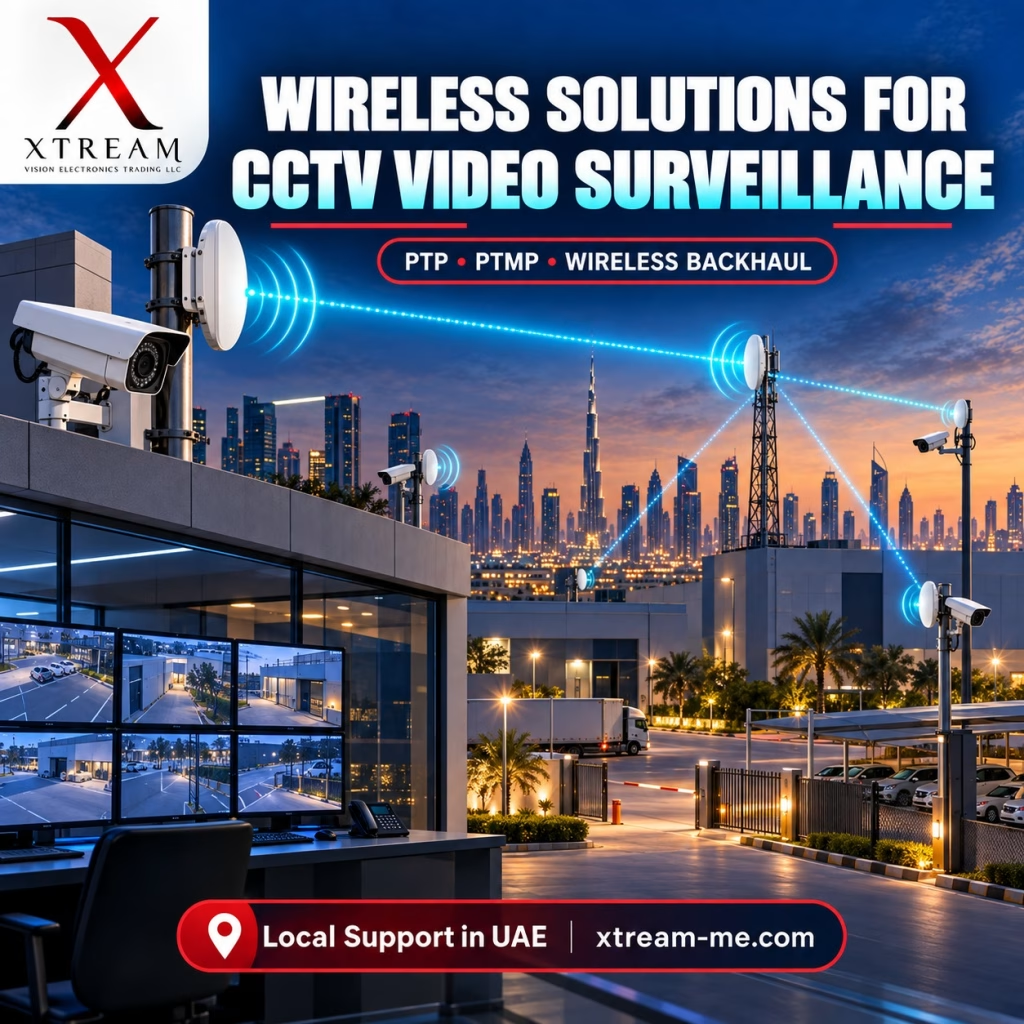
Modern CCTV systems often need to connect cameras across warehouses, construction sites, industrial facilities, campuses, parking areas and remote locations. Installing fiber or underground network cables between every camera location can be expensive, slow and sometimes physically impossible.
A professionally designed wireless solution for CCTV video surveillance can transport high-resolution video from remote IP cameras to a central control room or network video recorder without extensive civil work.
Xtream Vision Electronics Trading LLC supplies wireless PTP, PTMP and microwave solutions for CCTV projects, with technical assistance and local support from Dubai, UAE.
What Is a Wireless CCTV Backhaul?
Wireless CCTV backhaul is the network connection that carries video from one or more remote cameras to the monitoring or recording location.
The cameras still connect using Ethernet to a nearby network switch or wireless radio. The outdoor radio then transports the video traffic across the wireless link.
A typical CCTV wireless bridge works as follows:
IP cameras → PoE switch → Outdoor wireless radio → Wireless link → Receiving radio → Core switch or NVR
The wireless radios function as a network bridge between the camera site and the control room.
This is different from a consumer Wi-Fi camera. Professional wireless backhaul uses dedicated outdoor radios, directional antennas and properly planned network capacity.
Where Can Wireless CCTV Solutions Be Used?
Wireless video-surveillance networks can be deployed in many environments, including:
- Construction sites
- Warehouses and logistics yards
- Factories and industrial facilities
- Oil and gas sites
- Airports and ports
- Schools and university campuses
- Hotels and resorts
- Shopping centres
- Parking areas
- Gated communities
- Farms and remote properties
- Roads and traffic-monitoring projects
- Solar plants and utility facilities
- Government and smart-city projects
- Temporary events and project sites
Wireless connectivity is especially useful when cameras must be installed across roads, between buildings, on towers or in locations where fiber installation is difficult.
Point-to-Point Wireless for CCTV
A point-to-point wireless link connects two fixed locations.
For example, several cameras at a warehouse may connect to a PoE switch. A PTP radio installed at the warehouse sends the combined video traffic to another radio at the security control room.
PTP is suitable for:
- One camera site connected to one control room
- Building-to-building CCTV links
- Gatehouse connectivity
- Remote parking areas
- High-capacity camera clusters
- Long-distance surveillance links
- Connecting an NVR in a separate building
Both radios should have a clear signal path and sufficient Fresnel-zone clearance. The required distance, bandwidth and environmental conditions determine which radio and antenna should be used.
Point-to-Multipoint Wireless for CCTV
A point-to-multipoint network connects one central base station to several remote camera locations.
Each remote site has a subscriber radio connected to one or more cameras. The central access point receives video from all subscriber locations and transfers it to the control room.
PTMP is suitable for:
- Multiple camera towers
- Large parking areas
- Industrial compounds
- Campuses
- City surveillance
- Traffic-monitoring systems
- Perimeter-security projects
- Oil fields and utility sites
- Multiple gates or remote buildings
The central access point must have sufficient capacity for the combined traffic from every remote location.
PTMP design must consider the number of subscriber radios, sector coverage, camera bandwidth, distance, interference and expected future expansion.
PTP or PTMP: Which One Is Better for CCTV?
Neither architecture is automatically better. The correct design depends on how the camera locations are arranged.
| Project requirement | Recommended approach |
|---|---|
| One remote camera site | Point-to-point |
| Several cameras at one remote building | Point-to-point |
| Multiple remote camera poles in one coverage area | Point-to-multipoint |
| High-bandwidth camera cluster | Dedicated point-to-point |
| Several camera sites in different directions | Multiple PTP links or PTMP sectors |
| Mission-critical camera location | Dedicated PTP with redundancy |
| Long chain of camera towers | Carefully designed PTP topology |
| Large surveillance network | Combination of PTP and PTMP |
A large CCTV project may use PTMP links for individual camera locations and PTP links to carry aggregated traffic back to the main control room.
How Much Bandwidth Does a CCTV Wireless Link Need?
The wireless link must be designed around the combined video bitrate of all connected cameras.
The required bandwidth depends on:
- Number of cameras
- Camera resolution
- Frames per second
- Video codec
- Configured bitrate
- Image complexity
- Main and secondary streams
- Audio recording
- Additional network traffic
- Future camera expansion
A simple calculation is:
Required CCTV bandwidth = Number of cameras × Average bitrate per camera
For example, if eight cameras are configured to transmit an average of 8 Mbps each:
8 cameras × 8 Mbps = 64 Mbps
The link should not be designed for exactly 64 Mbps. Additional capacity is needed for bitrate variations, protocol overhead, management traffic and future expansion.
A practical design should include sufficient spare capacity so the wireless link does not operate continuously near its maximum usable throughput.
Always use the camera’s configured bitrate or actual measured traffic for final calculations. Resolution alone is not enough to determine bandwidth.
Wireless Data Rate vs Usable Throughput
The maximum wireless data rate displayed by a radio is not the same as the usable network throughput available for CCTV traffic.
Actual throughput is affected by:
- Signal strength
- Signal-to-noise ratio
- Channel width
- Radio modulation
- Frequency interference
- Link distance
- Antenna alignment
- Protocol overhead
- Environmental conditions
- Traffic direction
- Connected subscriber count
Equipment should be selected using expected real-world throughput under the planned conditions.
Choosing the Right Frequency
5 GHz
The 5 GHz band is widely used for outdoor CCTV links. It offers a practical balance between capacity, range, equipment availability and cost.
However, 5 GHz can be congested in urban areas. A spectrum scan and proper channel selection are important.
Some channels may also be subject to Dynamic Frequency Selection. A radio operating on a DFS channel may be required to change frequency when radar activity is detected. This must be considered for applications where continuous video transmission is critical.
6 GHz
The 6 GHz band can provide additional spectrum and wider channel options in supported regions. It may be useful where the 5 GHz environment is heavily congested.
Equipment availability and local frequency regulations must be confirmed before deployment.
60 GHz
The 60 GHz band can provide high capacity over shorter distances. Its narrow beam and propagation characteristics allow multiple links to operate in dense areas with reduced interference.
A 60 GHz design must consider:
- Link distance
- Rain attenuation
- Antenna alignment
- Mounting stability
- Required availability
- Backup-link requirements
Licensed Microwave
Licensed microwave links may be suitable for large or mission-critical surveillance networks that require protected spectrum, high availability and predictable performance.
These solutions are commonly considered for:
- Airports
- Ports
- Government projects
- Oil and gas facilities
- Utilities
- City surveillance
- Critical infrastructure
- High-capacity backhaul
Frequency licensing and regulatory approval may be required.
Wireless Products for CCTV Connectivity
Xtream can recommend different wireless platforms based on the project requirements.
LigoWave
LigoWave solutions can be considered for:
- Cost-effective PTP links
- Building-to-building CCTV connections
- Light backhaul
- PTMP camera networks
- Remote-camera connectivity
- Industrial surveillance applications
LigoDLB products can support many standard CCTV and light-backhaul requirements. LigoPTMP can be considered for industrial point-to-multipoint networks, while LigoPTP is available for dedicated wireless links.
RADWIN
RADWIN can be considered for:
- High-capacity PTP backhaul
- Large PTMP surveillance networks
- Smart-city applications
- Interference-sensitive environments
- Carrier-grade deployments
- Critical infrastructure
The final product must be selected according to the required throughput, distance, frequency, topology and availability.
Professional Microwave Links
Microwave solutions can support high-capacity and long-distance CCTV backhaul where unlicensed wireless equipment does not meet the project requirements.
Important Requirements for a Reliable CCTV Link
Clear Line of Sight
Outdoor directional radios normally require a clear signal path. Buildings, trees, metal structures and terrain can reduce signal quality or completely block the link.
Fresnel-Zone Clearance
The area surrounding the direct signal path must have sufficient clearance. An object does not need to block the centre of the path to affect wireless performance.
Proper Antenna Alignment
Directional antennas must be accurately aligned. The installer should check signal strength, noise, signal quality and modulation while adjusting both ends.
Stable Mounting
Movement caused by wind can affect narrow-beam antennas. Poles, brackets and towers must be suitable for the selected equipment and local conditions.
Outdoor Cabling
Use shielded, outdoor-rated Ethernet cable with suitable connectors. Cable entries should be protected against moisture, and drip loops should be included where appropriate.
Grounding and Surge Protection
Outdoor radios, poles and network cables should be properly grounded. Suitable surge protection helps protect switches, recorders and other equipment.
Reliable Power
Remote camera sites need stable power for the cameras, PoE switch and wireless radio. UPS or solar power may be required for locations without dependable utility power.
Network Design for CCTV Surveillance
A professional wireless CCTV design should include more than radio selection.
VLAN Separation
CCTV traffic can be placed in a dedicated VLAN to separate it from business, internet, voice and management traffic.
Quality of Service
Quality of Service can prioritize important video or control traffic when several services share the same link.
Multicast and Broadcast Control
Poorly controlled broadcast or multicast traffic can consume wireless capacity. Switches and radios should be configured according to the CCTV application.
IP Address Planning
Every radio, switch, camera and recorder should have a documented management address. A consistent IP plan simplifies monitoring and troubleshooting.
Network Monitoring
The system should monitor radio availability, signal levels, throughput, Ethernet status and other important performance indicators.
Cybersecurity
Use strong administrator passwords, secure management protocols, updated firmware and restricted management access. Network segmentation and firewall rules can provide additional protection.
Redundancy for Critical CCTV Networks
Some surveillance projects cannot tolerate a single link failure.
Possible redundancy options include:
- A secondary wireless link
- Two different frequency bands
- Ring or loop network architecture
- Separate routes to the control room
- Redundant network switches
- Backup power
- Fiber as the primary link and wireless as backup
- Wireless as the primary link and mobile or fiber backup
The redundancy method should match the operational importance of the cameras and the acceptable recovery time.
Common Causes of CCTV Video Problems
Wireless CCTV problems are not always caused by insufficient advertised radio speed.
Common causes include:
- Poor antenna alignment
- Weak signal
- High interference
- Incorrect channel width
- Overloaded PTMP access point
- Insufficient real throughput
- Damaged Ethernet cable
- Packet loss
- Incorrect duplex negotiation
- Unstable power
- Broadcast storms
- Poor switch configuration
- Camera bitrate peaks
- DFS frequency changes
- Obstructions entering the signal path
Testing should cover the entire path from the camera to the NVR, not only the wireless connection.
Testing a Wireless CCTV Network
After installation, test the system while all intended cameras are streaming.
The acceptance test should check:
- Signal strength
- Signal-to-noise ratio
- Modulation stability
- Wireless capacity
- TCP and UDP throughput
- Latency
- Packet loss
- Ethernet errors
- Video quality
- Live-view performance
- Recording stability
- Playback from the NVR
- Performance during peak traffic
A radio may show a high connection rate while still experiencing packet loss or unstable modulation. Application-level testing is therefore essential.
Wireless CCTV vs Fiber Cabling
| Feature | Wireless CCTV Backhaul | Fiber Cabling |
|---|---|---|
| Deployment | Outdoor radios at each location | Physical cable between sites |
| Civil work | Usually limited | Trenching and ducting may be required |
| Installation time | Often faster | Can take longer |
| Road crossings | No physical cable crossing | Permits may be required |
| Capacity | Depends on wireless platform | Very high |
| Interference | Requires frequency planning | Not affected by radio interference |
| Physical damage | No inter-site cable to cut | Cable can be damaged by construction |
| Relocation | Radios can be relocated | Installed cable is fixed |
| Main requirement | Suitable wireless path | Suitable cable route |
Wireless and fiber can also be used together. Fiber may connect the main sites, while wireless links connect remote camera poles and locations that are difficult to reach by cable.
Information Required for a CCTV Wireless Proposal
To recommend the correct solution, send Xtream:
- GPS coordinates or Google Maps pins for every location
- Distance between the camera sites and control room
- Camera quantity at each location
- Camera models
- Resolution and frame rate
- Configured main-stream bitrate
- Mounting height at each site
- Site photographs
- Required recording and live-view arrangement
- Existing network diagram
- Required availability
- Power availability
- Future expansion plans
With this information, the technical team can calculate the aggregated bandwidth and recommend a suitable PTP, PTMP or microwave architecture.
Why Choose Xtream for Wireless CCTV Solutions?
Xtream Vision Electronics Trading LLC supplies wireless networking and telecommunications solutions from Dubai.
We support CCTV contractors, system integrators, enterprises, ISPs and project owners with:
- PTP and PTMP network design
- CCTV bandwidth calculations
- LigoWave wireless solutions
- RADWIN wireless solutions
- Professional microwave links
- Link-budget calculations
- Frequency and antenna selection
- VLAN and network planning
- Equipment configuration
- Installation coordination
- Remote technical support
- Troubleshooting
Our team can help select a cost-effective wireless link for a small CCTV project or design the backhaul architecture for a large surveillance network.
Frequently Asked Questions
Can CCTV cameras work over a wireless bridge?
Yes. A properly designed wireless bridge can transport IP camera video to an NVR or control room. The link must provide sufficient real throughput and stable network performance.
How many cameras can one wireless link support?
The number depends on each camera’s configured bitrate and the usable capacity of the link. Calculate the combined bitrate of all cameras and include additional capacity for overhead, traffic peaks and expansion.
Is Wi-Fi suitable for CCTV cameras?
Professional outdoor wireless radios can support CCTV backhaul when the system is correctly designed. Consumer Wi-Fi routers are generally unsuitable for long-distance or critical outdoor surveillance links.
Is PTP or PTMP better for CCTV?
PTP is suitable for dedicated connections between two locations. PTMP is useful when several remote camera locations connect to one central point. Large projects may use both.
Can wireless CCTV work over several kilometres?
Yes, suitable equipment can connect sites over several kilometres when there is adequate line of sight, Fresnel-zone clearance and a properly calculated link budget.
What happens if there is no line of sight?
The installer may need to increase the mounting height, move the radio, use an intermediate relay point or select another connection method. High-capacity outdoor links should not be designed through major obstructions.
Can one wireless link carry CCTV and internet traffic?
Yes, if the link has enough capacity. VLANs and Quality of Service should be used to separate and manage the different services.
Does wireless CCTV require internet access?
No. A wireless bridge can operate as a private local network between the cameras and the control room. Internet access is only required for remote viewing or cloud services.
Request a Wireless CCTV Solution
Need to connect remote cameras without expensive fiber cabling?
Send Xtream your camera list, site coordinates, distances and required mounting heights. Our team will assess your bandwidth and recommend a suitable point-to-point, point-to-multipoint or microwave solution.
Xtream Vision Electronics Trading LLC
Dubai, United Arab Emirates
Phone: +971 4 265 8330
Email: sales@xtream-me.com
Website: www.xtream-me.com
Contact Xtream for a reliable wireless CCTV backhaul solution with local technical support in the UAE.