

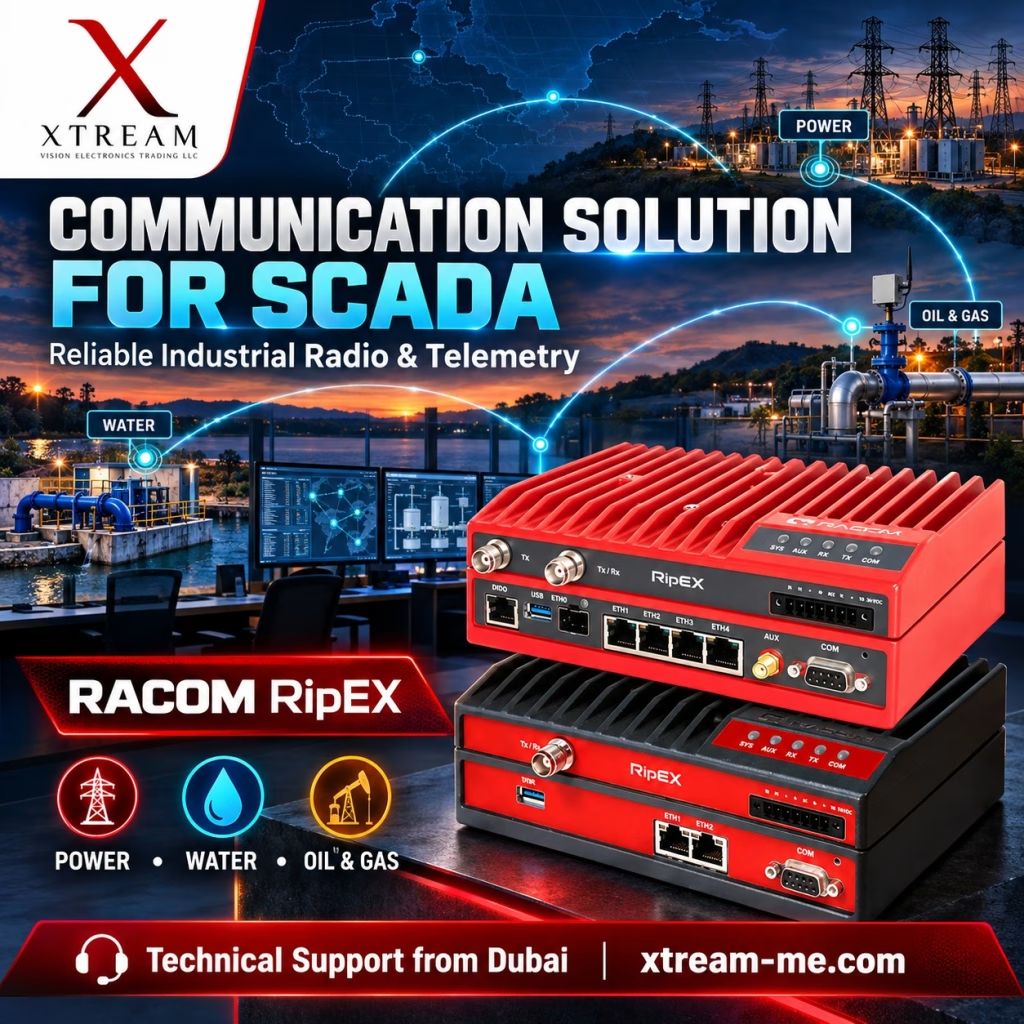
Communication Solutions for SCADA: Reliable Data Transfer with RACOM RipEX
SCADA systems depend on reliable communication between remote equipment and a central control room. Pumps, valves, substations, sensors, meters, variable-speed drives and remote terminal units must continuously exchange operational data, alarms and control commands.
In many industrial locations, fiber, mobile coverage or wired Ethernet may be unavailable, unreliable or too expensive to deploy. An industrial radio network provides an independent communication path across large areas without requiring continuous cabling between every site.
The RACOM RipEX industrial radio modem is designed for mission-critical SCADA and telemetry applications. It combines radio communication, routing, security and industrial interfaces in a robust platform suitable for power, water, oil and gas, mining and environmental-monitoring networks.
Xtream Vision Electronics Trading LLC provides RACOM wireless communication solutions, network planning and technical support from Dubai, UAE.
What Is a SCADA Communication Network?
SCADA stands for Supervisory Control and Data Acquisition. A SCADA system collects information from remote industrial equipment and allows operators to monitor or control the process from a central location.
A typical SCADA network includes:
- Sensors and measuring instruments
- Programmable Logic Controllers
- Remote Terminal Units
- Variable-Speed Drives
- Flow and pressure meters
- Pumps and valves
- Protection relays
- Local control panels
- Communication gateways
- SCADA servers
- Human-Machine Interfaces
The communication network transfers data between these components.
For example, a remote pumping station can send water pressure, tank level, pump status and alarm information to the control room. The operator can then issue a start, stop or set-point command through the same network.
Why SCADA Requires a Specialized Communication Solution
SCADA traffic normally uses relatively small data packets, but these messages can be operationally critical. A delayed alarm or failed control command can affect production, safety and service availability.
A suitable SCADA communication system should provide:
- Continuous operation
- Predictable latency
- Secure data transmission
- Long-distance coverage
- Support for Ethernet and serial devices
- Multiple communication routes
- Remote diagnostics
- Industrial temperature tolerance
- Protection against unauthorized access
- Integration with existing RTUs and PLCs
- Backup and redundancy options
Consumer Wi-Fi routers and ordinary office networking equipment are generally unsuitable for harsh, remote or mission-critical industrial applications.
Introducing RACOM RipEX
RACOM RipEX is an industrial radio and cellular communication platform developed for critical SCADA and telemetry networks.
RACOM describes RipEX as a 24/7 wireless data-transfer platform engineered for reliability, security and low latency. It is used in infrastructure sectors including power, water, oil and gas, mining and environmental monitoring.
RipEX can create an independent private radio network between remote industrial locations and a central control centre.
A simplified network may operate as follows:
Sensor or industrial device → PLC/RTU → RipEX radio → Radio network → RipEX radio → SCADA server
RipEX can transport data from both modern Ethernet equipment and older serial devices, depending on the selected model and configuration.
Main Benefits of RACOM RipEX for SCADA
Independent Private Communication
RipEX allows an organization to build a private industrial radio network without depending entirely on a public cellular operator.
This can be valuable in remote areas, deserts, mountains, mines, pipelines and utility networks where mobile coverage may be weak or unavailable.
A private network also gives the operator greater control over coverage, routing, security and maintenance.
Long-Range UHF Communication
RipEX is available for frequencies including 160, 300, 400, 800 and 900 MHz. Lower-frequency industrial radio can provide useful propagation characteristics for wide-area SCADA and telemetry networks.
The actual distance depends on:
- Operating frequency
- Transmit power
- Antenna gain
- Antenna height
- Terrain
- Obstructions
- Cable losses
- Receiver sensitivity
- Channel bandwidth
- Required availability
- Local regulations
A radio-path calculation and site survey should be completed before finalizing the equipment and antenna system.
No Dedicated Base Station Required
RipEX supports network architectures that can extend coverage through routing and repeater sites without requiring a traditional cellular-style base station. RACOM highlights dynamic routing and coverage expansion without dedicated base stations among its key platform capabilities.
This enables flexible topologies for pipelines, utility networks and geographically distributed industrial facilities.
Ethernet and Serial Connectivity
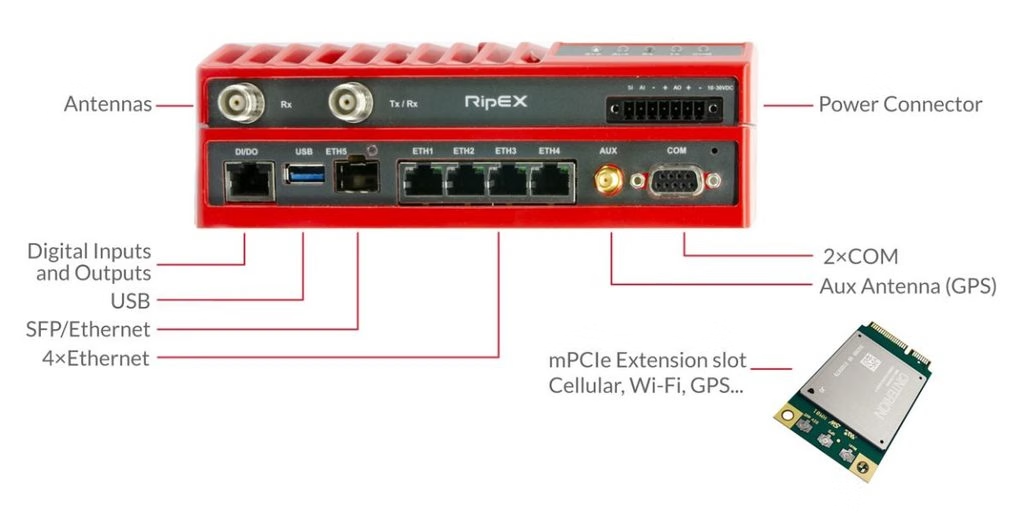
Depending on the RipEX version, available connectivity can include multiple Ethernet ports, serial communication ports, USB, SFP, digital inputs and outputs, antenna connections and hardware alarm interfaces.
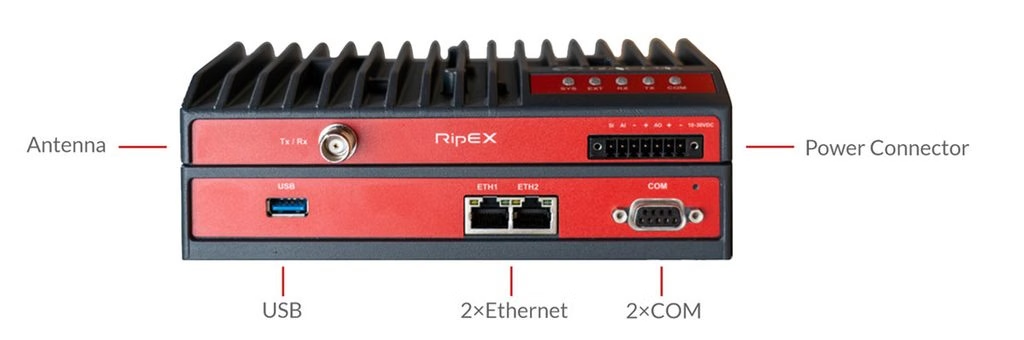
RACOM lists up to four Ethernet ports, one SFP interface, two serial ports, two digital inputs and two digital outputs for the broader RipEX platform configuration, while the compact RipEX2e configuration includes two Ethernet ports, two serial ports and hardware alarm input and output.
This allows RipEX to integrate with:
- Modern Ethernet RTUs
- Serial RTUs
- PLCs
- Modbus devices
- IEC-based utility devices
- DNP3 equipment
- Industrial gateways
- Protection relays
- Metering equipment
- Legacy field devices
Protocol support and compatibility should be verified against the specific RTU, PLC and SCADA application.
SCADA Applications for RACOM RipEX
Water and Wastewater Networks
Water utilities often operate assets across large geographic areas.
RipEX can connect:
- Pumping stations
- Reservoirs
- Water tanks
- Treatment plants
- Flow meters
- Pressure sensors
- Valve chambers
- Boreholes
- Sewage-lifting stations
The control room can collect measurements, receive alarms and send commands to remote equipment.
Power Distribution
Electrical utilities require dependable communication with substations and field equipment.
Possible applications include:
- Substation automation
- Recloser monitoring
- Protection relays
- Fault indicators
- Transformer monitoring
- Distribution automation
- Metering
- Renewable-energy sites
Oil and Gas
Oil and gas infrastructure often extends across deserts and remote areas where fixed connectivity is unavailable.
RipEX can support communication with:
- Pipeline valves
- Pumping stations
- Wellheads
- Tank farms
- Metering stations
- Pressure and flow sensors
- Leak-detection systems
- Remote control panels
Mining
Mining sites require industrial communication across open-pit mines, processing plants and remote operational areas.
A radio network can connect monitoring equipment, pumps, environmental sensors and control systems where installing cables is impractical.
Environmental Monitoring
RipEX can transport data from remote:
- Weather stations
- Flood-monitoring sensors
- River-level instruments
- Air-quality monitors
- Seismic equipment
- Rain gauges
- Dam-monitoring systems
Transportation Infrastructure
Industrial radio can also support telemetry and control for railways, road infrastructure, tunnels, ports and traffic-management systems.
Network Topologies Supported by Industrial Radio
The most suitable topology depends on the location of the field devices and the availability required by the application.
Point-to-Point
Two RipEX radios create a dedicated communication link between one remote location and the control centre.
This is suitable for a single pumping station, substation or industrial facility.
Point-to-Multipoint
A central location communicates with several remote sites.
This is commonly used for water networks, power distribution, oil fields and remote metering.
Repeater Network
A repeater extends coverage to locations that cannot communicate directly with the control centre.
Repeaters may be installed on towers, hills or strategically positioned industrial sites.
Mesh and Routed Network
Dynamic routing can provide multiple communication paths. If one route becomes unavailable, traffic may be redirected through another suitable path, depending on the network design.
This can improve resilience across large SCADA networks.
Redundant Network
Critical applications may use:
- Redundant control-centre radios
- Backup communication routes
- Dual power supplies
- Alternative frequencies
- Separate antenna systems
- Cellular backup
- 1+1 hardware redundancy
RACOM lists backup routes and 1+1 redundancy among the reliability features available for RipEX deployments.
RipEX Performance
RipEX supports channel bandwidths from 6.25 kHz to 300 kHz, adaptive modulation from 2CPFSK through 256-QAM, and half- or full-duplex operation in supported configurations. RACOM specifies speeds of up to 1.7 Mb/s for the platform.
This capacity is intended for industrial telemetry, commands, alarms and operational information.
RipEX is suitable for applications such as:
- Modbus polling
- RTU data collection
- PLC communication
- Alarm transmission
- Equipment start and stop commands
- Status updates
- Sensor readings
- Remote configuration
It is not intended to replace a broadband microwave link for applications such as high-resolution video surveillance or bulk file transfer. Where a project combines SCADA with CCTV or high-volume data, separate broadband wireless capacity may be required.
Security for Critical Infrastructure
SCADA communication can involve sensitive operational data and control commands. Security must therefore be included from the beginning of the network design.
RACOM lists the following security capabilities for RipEX:
- IPsec
- OpenVPN
- AES-256
- RADIUS
- Firewall
- VLAN support
- Digitally signed firmware
- Secure Boot
- Hardware tamper detection
- IEC 62443-4-2 alignment
These controls help protect data, restrict network access and reduce the risk of unauthorized device modifications.
Security should also include:
- Strong unique passwords
- Role-based access
- Restricted management addresses
- Firewall policies
- Network segmentation
- Configuration backups
- Firmware-management procedures
- Security-event monitoring
- Physical access control
- Documented incident-response procedures
Industrial Reliability
RipEX is designed for harsh industrial conditions. RACOM specifies an operating temperature range from −40°C to +70°C and states that individual units are tested in a climatic chamber. The manufacturer also lists an MTBF exceeding 100 years.
A reliable field installation must also include:
- Correct outdoor antenna
- Low-loss coaxial cable
- Lightning protection
- Proper grounding
- Stable DC power
- UPS or battery backup
- Weatherproof connectors
- Suitable enclosure
- Adequate ventilation
- Secure mounting
- Periodic inspection
The radio alone cannot compensate for poor antenna placement, damaged cable or an unstable power system.
RipEX2 and RipEX2e
The RipEX family includes configurations for different project requirements.
RipEX2
RipEX2 is suited to larger or more demanding sites that need additional connectivity, expansion options or redundancy features.
Depending on the configuration, it can provide:
- Multiple Ethernet interfaces
- SFP connectivity
- Two serial ports
- Digital inputs and outputs
- Multiple antenna connections
- Hardware alarm interfaces
- mPCIe expansion
- Cellular, Wi-Fi or GPS options
RipEX2e
RipEX2e is a more compact option for field locations requiring essential Ethernet and serial connectivity.
The most suitable model depends on:
- Required interfaces
- Radio frequency
- Duplex mode
- Redundancy
- Cellular backup
- GPS requirements
- Number of connected devices
- Site power
- Environmental conditions
Modbus Communication Over RipEX
Modbus is widely used in SCADA systems to exchange data with PLCs, RTUs, meters and variable-speed drives.
RipEX can provide the communication path for:
- Modbus TCP over Ethernet
- Modbus RTU over serial connections
- Mixed Ethernet and serial sites using appropriate configuration or gateways
Before designing the network, identify:
- Every device brand and model
- Modbus register map
- Unit or slave address
- Communication speed
- Parity and stop bits
- Polling interval
- Number of registers
- Read and write commands
- Required response time
- Ethernet or serial interface
- Expected communication volume
Different device models may use different Modbus register addresses even when they perform similar functions. The SCADA software must use the correct register mapping for each device.
Radio-Network Design Requirements
A professional RipEX design should include the following steps.
Site and Path Assessment
Collect GPS coordinates, terrain profiles, antenna heights and information about obstructions.
Frequency Planning
Confirm the authorized operating frequency, bandwidth and transmit power with the relevant regulator.
Link-Budget Calculation
Calculate:
- Transmit power
- Antenna gain
- Cable loss
- Path loss
- Received signal level
- Receiver sensitivity
- Fade margin
Traffic Calculation
Estimate the traffic generated by every RTU, including polling, responses, alarms, retries and management traffic.
Antenna Selection
Choose omnidirectional, sector or directional antennas based on the topology and coverage requirements.
Availability Planning
Determine the required availability and whether repeaters, alternate routes or redundant equipment are necessary.
Cybersecurity Design
Define VPNs, VLANs, firewall policies, authentication and management-access rules.
Power Design
Confirm the DC supply, backup time, battery capacity, solar requirements and surge protection for every site.
Information Required for a RipEX Proposal
To prepare a project-specific recommendation, provide:
- Number of remote sites
- GPS coordinates of all locations
- Control-room location
- Required operating frequency
- Available channel bandwidth
- RTU, PLC or VSD models
- Ethernet or serial interface requirements
- Communication protocols
- Polling interval
- Estimated data volume
- Required latency
- Antenna and tower heights
- Power availability
- Redundancy requirements
- Local regulatory requirements
- Network diagram, if available
Why Choose Xtream for RACOM RipEX Solutions?
Xtream Vision Electronics Trading LLC provides industrial wireless and telecommunications solutions from Dubai, UAE.
We can assist customers and system integrators with:
- RipEX product selection
- SCADA radio-network architecture
- Coverage and path studies
- Link-budget calculations
- Frequency planning
- Antenna selection
- Traffic-capacity assessment
- Modbus communication planning
- Redundancy design
- Equipment configuration
- Factory and bench testing
- Installation guidance
- Commissioning support
- Remote troubleshooting
RACOM also provides design assistance, radio-path studies, bid support, commissioning assistance and an online technical HelpDesk.
Frequently Asked Questions
What is the best communication solution for SCADA?
The best solution depends on coverage, data volume, latency, availability and local infrastructure. Industrial radio is particularly useful for geographically distributed systems that need an independent private network.
What is RACOM RipEX?
RipEX is an industrial radio and cellular communication platform for SCADA, telemetry and critical infrastructure. It connects remote RTUs, PLCs and industrial devices to a central control system.
Can RipEX transmit Modbus data?
Yes. RipEX can provide connectivity for Ethernet and serial industrial devices. The design must match the Modbus TCP or Modbus RTU configuration used by the equipment.
Can RipEX send start and stop commands?
Yes. When integrated with the RTU, PLC, drive and SCADA software, the communication network can carry control commands such as start, stop and set-point changes. Safety interlocks and control logic remain the responsibility of the industrial control system.
Does RipEX require mobile-network coverage?
A radio-only RipEX network can operate independently of public mobile coverage. Cellular connectivity may also be added in suitable configurations for backup or hybrid communication.
Can RipEX be used as a repeater?
Yes. RipEX networks can use routing and repeater locations to reach sites that do not have a direct path to the central station.
Is RipEX suitable for CCTV transmission?
RipEX is optimized for SCADA and telemetry data. High-resolution CCTV normally requires a separate broadband wireless, microwave or fiber solution.
What speed does RipEX support?
RACOM specifies data rates of up to 1.7 Mb/s, depending on frequency, channel width, modulation, signal conditions and regulatory limits.
Request a RACOM RipEX SCADA Solution
If you need secure and reliable communication between a control room and remote RTUs, PLCs, meters, pumps or variable-speed drives, Xtream can help design the appropriate RACOM RipEX network.
Send us your site coordinates, device list, protocol requirements and network diagram for an initial technical assessment.
Xtream Vision Electronics Trading LLC
Dubai, United Arab Emirates
Phone: +971 4 265 8330
Email: sales@xtream-me.com
Website: www.xtream-me.com
Contact Xtream to discuss a RACOM RipEX communication solution for your SCADA and telemetry network.